Falaise
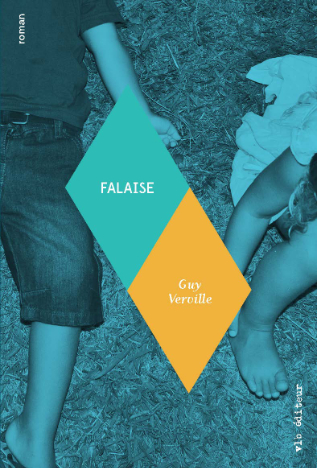
Available from your bookstore or online store
Reviews of the first edition
The DNA of Love and Hate
Although Falaise is his fourth novel, this is my first encounter with Guy Verville. I was drawn to the book’s premise: four children raised in the utopia of sexual liberation return home after fifteen years away for their father’s funeral. Each discovers that making peace with the past is no easy matter.
Serj, Yvonne, Héloïse and Xavier had “combative, pleasure-seeking, artistic and, above all, grotesque parents.”
André and Diane raised their four children without knowing how to love them. They allowed perverse demons to prowl around them, lies to seep between the four walls, and truths to cling “inside locked closets.”
As a child, Xavier watched his parents through the keyhole; he saw too much of André and Diane “to admire, understand or love them.” For the others, childhood was a deception, a dark thought.
André’s will states that his assets have been placed in trust. Anyone claiming to be his child and hoping to inherit will have to take a DNA test. The author adds that “hate and love form a tangled rosary of DNA.”
Hate and love constantly echo one another throughout this finely crafted novel. At times, the author seems to describe how a character learns to “homogenize his bitterness.”
We often hear that tomorrow is another day, that we must take things “sixty minutes at a time—and, if possible, a shot of gin every fifteen!”
Guy Verville’s style moves across several registers: sarcastic, philosophical, poetic and erotic. He writes that André “preferred to travel, enlightened and guided by drugs, staggering through the fragrances of desire while swallowing the winding words of seasonal sirens.”
As noted earlier, the children were raised during the hippie era, in the age of peace and love. The youngest son is comfortably gay and always ready for pleasure, even with his bisexual brother.
Xavier likes to recount his adventures. He explains that, instead of doing it in the bushes, he could have taken the boy to a hotel room and “made love to him while promising they would be happy together for the rest of their lives. But it is easier to empty one’s balls than to quench one’s heart.”
The children are now between forty-one and fifty-two years old. None is married. Curiously, Yvonne and Héloïse each meet the love of their life during this painful return to the family home.
Even though their dead father still seems intent on bringing the survivors to heel, the heart’s excesses escape his orchestration from beyond the grave.
Falaise is a 310-page novel without chapters, only subheadings every two, three, four or five pages. States of mind generally take precedence over spectacular twists. Here, Guy Verville proves himself a perceptive psychologist.
A Wonderful Discovery!
A dark premise if ever there was one! Following their father’s death, two brothers and two sisters gather at the home of the mother they have not seen in nearly fifteen years. From the outset, a certain mystery hangs over the cause of their exile: their father was both unfaithful and violent, but the past seems to conceal even murkier waters. A great lover—quite literally—of the libertinism of the 1960s, he had created a paradise in which the children had little place, and where free love concealed an occasionally sordid secrecy.
Serj, Héloïse, Xavier and Yvonne therefore reunite with their mother and her sister to lance a boil that should have been dealt with long ago. Each arrives with a burden of secrets and memories. Xavier used to spy on the orgies his parents attended so that he could better gaze at the bodies of the men who fascinated him. Yvonne is embittered by missed opportunities and a happiness that eludes her. Héloïse seems nostalgic for a past she is not even sure truly existed. Serj, a forensic pathologist accustomed to searching for truth in anonymous flesh, nevertheless remains an almost impenetrable wall, revealing nothing of his fears, his aspirations or the object of his desire. And why has their father’s study been sealed off? With such an opening, one might expect a very sombre tone, yet author Guy Verville navigates remarkably well among often conflicting emotions, brilliantly evoking a fabric of complex relationships and truths both great and small. A wonderful discovery!
Like Zola
As I delved into the opening sections of your latest novel, I found work worthy of the great NRF publications—of that I am certain. Without knowing your literary influences, I immediately perceived a style that can readily stand beside Sylvie Germain, Marie NDiaye or even Éric Fottorino. That is the style.
As for the substance—the place where you seek to bring emotion to us and to your characters—you guide us wonderfully toward unsuspected paths, as though we had everything to learn, because human beings can never be entirely transparent to us. The example I will give is rather classical, but in my view only Zola masters this art so well: his characters are immersed in savage capitalism while their humanity remains intact. This art carries over into your book through Diane and her children, since there is never an easy resolution to their feelings toward their parents. They retain their childish, selfish impulses, like Anne Frank toward her parents, or like the childhood portrayed by Nancy Huston in Fault Lines. Yet their adult condition often brings them back to reality, leaving the reader in a pleasant state of suspense—pleasant because, while reading you, one feels something extremely powerful: one trusts you. When that bond of trust develops naturally between reader and author, the reading becomes justified and, above all, pleasurable.
I took some time before sharing my thoughts because I wanted to let the whole question of dialogue mature within me; in that respect, your novel helped me uncover a few answers. Dialogue in literature strikes me as delicate, because it directs emotion only at the surface. I realize this as I browse through various books. As in real life, what comes out of our mouths is of little importance; everything happens in the emotions we feel, in our minds. Dialogue may carry more weight in literature when it serves an analytical exchange between characters, as Amélie Nothomb uses it, for example. But whenever there is a great deal of dialogue, the construction of knowledge becomes very delicate. Your novel’s structure made me think somewhat of Tracy Chevalier’s The Lady and the Unicorn; she uses dialogue more sparingly, however, and concentrates the action more fully within her characters’ minds. Different characters may even answer one another in turn, but always through the perspective of one of them—we need only think of Jonathan Littell’s celebrated The Kindly Ones, though Tracy Chevalier is by far the better example. Given your novel’s structure, in which every section bears a title such as “The Mother, the Children,” it would have been easy to choose that path and let the dialogue among the characters arise through the mind of a single character. In any case, the question is highly complex. If dialogue is so delicate to handle, it is because the author must first reflect on the epistemological basis of the work, since this is where, as I said earlier, the author decides how knowledge will be constructed. In short, it is a very, very long subject that we could explore together at greater length!
Congratulations on this latest offspring. The scale of the work is colossal—you can feel it—and I sincerely admire the courage it took to publish it.
(Personal correspondence)
Unease
(4 stars out of 5)
Sometimes family secrets ought to remain hidden. More often, however, it is better to lance the boil, even if doing so calls several lives into question. That is the premise of Falaise, the fourth novel by Montreal writer Guy Verville. Reunited for the funeral of their famous, distant and unfaithful father, his children confront their mother and revisit the reasons that drove them from the family nest more than a decade earlier, through very short chapters centred on one family member or another. On the menu are the parents’ pervasive sexuality and infidelity at the time, and wounds that still struggle to heal. The characters’ sexual tension, skilfully handled by the author, never crosses into vulgarity despite everyone’s apparent nonchalance and the unease that could itself serve as the book’s central subject. Though this is yet another quest for the Quebec father, the protagonists’ depth—as well as their weaknesses, decisions and ultimately constant selfishness—makes this “bunch of nutcases,” to quote one secondary character, devilishly endearing.
Unsettling
I read this novel over a few days during my vacation (OK, I had started it a little earlier because I simply could not wait). A vacation, for that matter, is an ideal time to absorb this very well told and tightly constructed story by Guy Verville—one that is also deeply unsettling.
First, I admit that I am a fan of the author, having read all his books with the greatest pleasure.
A keen observer of humanity, he portrays his characters with a deft touch. They are as flawed as they are endearing, as truthful as they are deceitful, as good as they are selfish. They are neither entirely white nor entirely black, but resolutely grey. This makes them credible.
The title Falaise is a fine metaphor for the fall of a dysfunctional family, the kind we all know. Diane, Rose, Héloïse, Serj, Xavier and Philippe each cultivate a secret garden in addition to sharing a family secret. Everything bursts into the open after their father’s death, when the time comes to read his will. Even then, we sense that the revelations are incomplete and that transparency is never total. We will never know what they truly feel for one another, especially what the children feel toward their parents. What remains unspoken is highly revealing in this wonderful text, because what we say often means less than what we feel.
I recommend this book without hesitation.