Putting Death on the Agenda: End-of-Life Stories
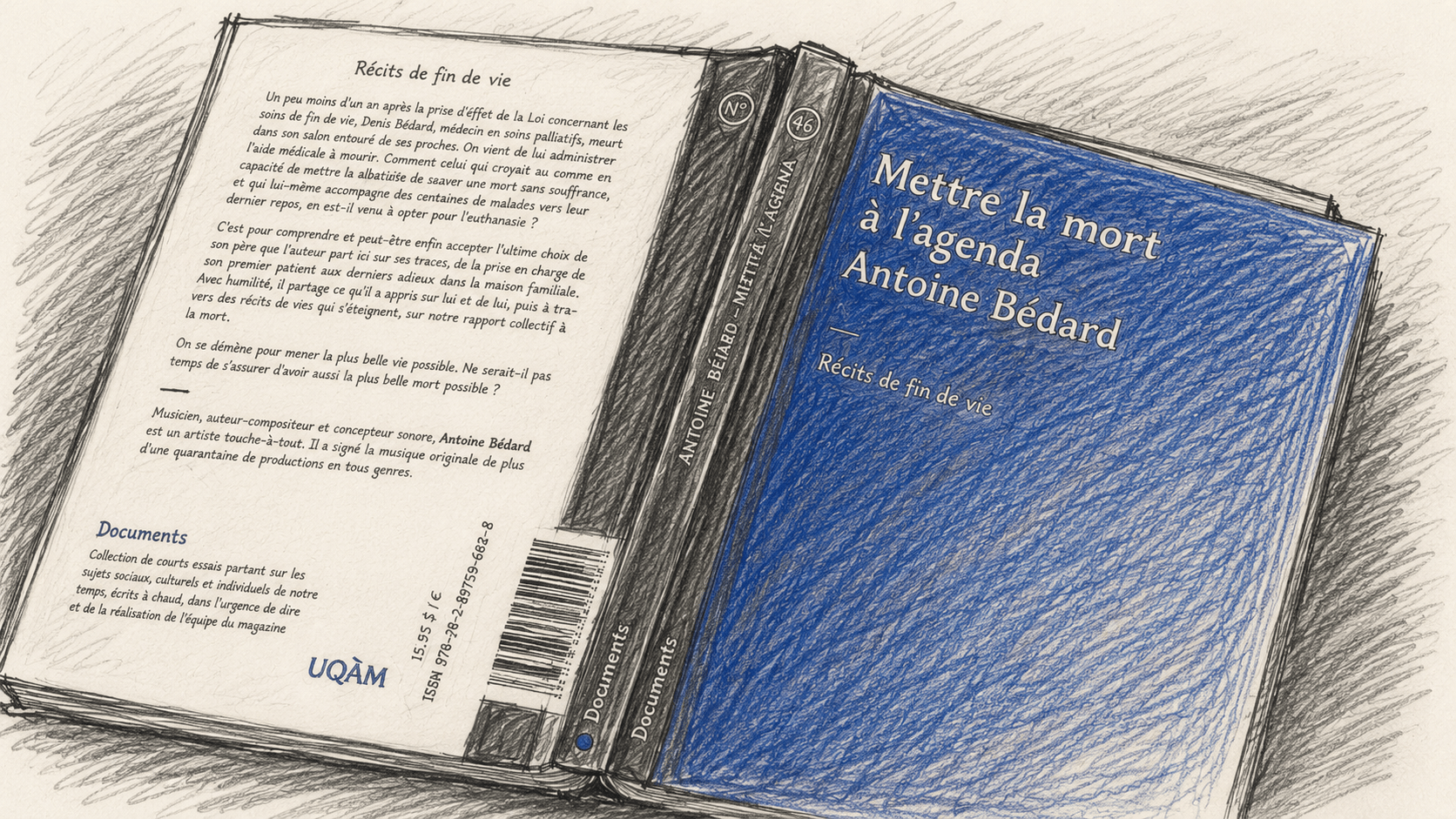
It was through an unexpected effect of synchronicity that I acquired Antoine Bédard's short book yesterday, Mettre la mort à l’agenda. Récits de fin de vie (Putting Death on the Agenda: End-of-Life Stories). Let us speak here of that chance which pushes us to look at a Facebook profile and suddenly transports us elsewhere, onto a diverging river.
I became interested in the work because the author and musician used the death of his father to talk about medical assistance in dying (MAID), something I had experienced during another one of those abrupt strokes of chance, namely, the death of my own father in 2023.
It turned out, upon reading the book, that the comparison stopped there. My story with my father has nothing to do with Bédard’s. His father was a doctor in the Far North before becoming a palliative care practitioner. The irony, as one quickly discovers, is that this doctor requested MAID as soon as it was authorized by law, whereas the type of care this doctor provided was precisely meant to be "palliative," a gentle accompaniment in the process of an end-of-life journey, a period that can span, contrary to the myth, several years.
His father thus dedicated his career to alleviating his patients’ overall suffering (physical, psychological, and spiritual). Diagnosed with an incurable blood disease, he saw his condition deteriorate over the course of a decade. Faced with worsening pain and the loss of his autonomy, he made the lucid choice to resort to medical assistance in dying as soon as the Act Respecting End-of-Life Care came into effect in Quebec.
To put his father's choice into perspective, Antoine Bédard draws a parallel with the death of his mother, which occurred sixteen years earlier from cancer. While his mother was terrified of death and fought to prolong her life despite palliative care that the author retrospectively judges to have been inadequate, his father welcomed death as a deliverance. This contrast allows Antoine Bédard to emphasize that end-of-life suffering is both physical and existential, and that one's relationship with death is profoundly individual.
The book also addresses the impact of MAID on those around the patient. The author recounts his initial incomprehension of his father's desire to end his life, and his decision, as the eldest child, not to be present for the lethal injection. Through subsequent discussions with his father's former colleagues and the doctor who administered the MAID, the musician makes halting progress toward acceptance. He suggests that his father's decision was not an abandonment, but rather the ultimate means of regaining control over a suffering that had become intolerable.
It is perhaps here that I was left wanting more. The book is undoubtedly too short to tackle the vast theme of medical assistance in dying in light of what palliative care should be. In doing so, it seems to me, it jolts entire realms of sensibilities and feelings.
Through short chapters, Antoine Bédard attempts to encompass everything, perhaps too much? He certainly does so with beautiful prose, unfortunately, overly refined by the publisher with inclusive-language edits that grate on both the prosody and the eyes. Thus, the author sometimes loses the humanity of his discourse by inserting, for example, the "questions from his daughter to her father," a sort of almost overly intellectualized bravado from the one who was about to die. After all, Denis Bédard was certainly no Socrates, and it seems to fall flat. Perhaps it is simply me seeing drama everywhere.
Nevertheless, reading Mettre la mort à l’agenda is worth the detour, to reflect on the phenomenon of MAID, as well as the unfinished debate regarding the effort we must all make to take charge of our lives and our deaths, allowing both the first and last stages of our existence to be lived in dignity and contained within the humility of our consciousness.
I certainly would have liked more dialogue between the father and his son. It seems it did not take place, not necessarily because of the father or the son, but because a barrier seemed to inexorably exist between them. This is nothing new. I have, so to speak, experienced it myself.
However, unlike the author, I was there for my father's final moments, but he was already disconnected from his life. In his case, medical assistance in dying was administered almost suddenly, despite rigorous compliance with the law. The morning of his death, we did not know he was going to die that day, at eight-twenty in the evening (I checked my watch; I am an astrologer, after all).
For Denis Bédard, the process was conscious. The man was still on his feet and had decided, a week earlier during a family council, on the moment of the lethal administration.
There is therefore no single way to die (or to live). We are lucky, in this country, to be able to dwell on it. It is a luxury that goes hand in hand with the responsibility it entails. The author's work has the merit of bringing us back to this questioning, which cannot be concluded by a simple ratification of a law.
Source: Mettre la mort à l’agenda. Récits de fin de vie. Antoine Bédard, Atelier 10. 2023. 80 pages.