Republishing and Translating "La Vie dure"
Thirty years ago, I handed my publisher at the time, Les Herbes rouges, a collection of short stories into which I had poured — or so I believed — my whole soul. He turned it down promptly, without explanation.
It's true that my relationship with that publisher had never been easy, even if I valued him for his rigour and his patience with me. He was, however, slow by nature, and I practically had to lose my temper before he finally brought out Crever mon fils.
His refusal probably had more to do with wanting to be rid of me. I didn't press him; it may even have been me who cut the ties. I had understood, while working through the edit of Crever mon fils, that François Hébert leaned toward flat, unadorned prose and didn't much care for my metaphorical, not to say overwrought, style. He did teach me restraint, though I've always thought he drained something out of the book. I don't hold it against him (not anymore). I'm somewhere else now.
Still, I was losing a prestigious publisher… I had the vague sense that my writing career would stop there.
A great deal changed during that year, 1996. To begin with, the small graphic design shop where I worked closed down. I had to turn on a dime and go on serving a few clients from home. That was the start of my life as a freelancer. It lasted seventeen years. It was then that I met, professionally, the publisher of Varia, Michel Bédard — a thoroughly likeable man, a bon vivant, who was looking for a typesetter.
You have to put yourself back in the period. 1996. The Internet is barely beginning, graphic design is in transition. The means are limited but promising. I have the skills to do everything a publishing house needs. Landlines and modems are still necessities. After one successful job, then another, I became, so to speak, the house typesetter.
Mr. Bédard learned that I wrote, that I had already published twice (Le Putain and Crever mon fils), and that I had a manuscript lying dormant after being rejected by other houses. In the end, I told myself, the thing must simply be bad…
Michel Bédard wanted to read it. I was uneasy: as his contractor, the last thing I wanted was for him to feel he owed me anything.
He came back to me a few weeks later saying he wanted to publish it. Varia was a new house, aimed mainly at non-fiction, philosophy and politics. This publisher had large ambitions, and was independent and proud of it.
He assured me it wasn't a favour, that he had particularly liked the story The Distance, and Thomas goes off to die as well. I don't think every text in the collection pleased him, The Love of the savages least of all, because of its homoerotic content. But being the free man he was, he had no intention whatsoever of curbing what I wrote. I will always be grateful to him for that.
La Vie dure thus appeared in 1997, in early summer. Silence from the critics. This didn't surprise me unduly, since Crever mon fils had met the same fate. François Hébert had warned me that reviewers wouldn't like my work — too harsh. "They think it's their duty to spare the reader," he said drily. It had taken a surprising review in Brussels's Le Soir before the papers here finally paid the book any attention. No one is a prophet in his own country?
La Vie dure eventually got a review in the magazine Fugues, and another in RG. Well — no doubt it was L'Amour des sauvages that had caught their interest!
The first review suggested the book had probably come out in the wrong season (summer) when its subject was winter. An odd observation, but perhaps a true one.
To make a long story short — though my introduction is running very long indeed — Varia had to close its doors a few years later. I managed to publish two more books there. Because the house was shutting down, I bought back the unsold copies, and then, in 2012, I revised L'Effet Casimir and Les Années rebours to bring them out as ePubs. I did almost nothing with them…
I don't know why I didn't do the same for La Vie dure. Perhaps precisely because those texts were too harsh. The two others at Varia were in a different register, more "accessible." That relative "softness" was deliberate. I wanted to break the mould of the severe writer of Crever mon fils and La Vie dure. At the expense of my true voice? That would be leaning a little too hard on self-pity. You are what you are at the moment you are it.
For two years now I've been thinking about going back into this book. What held me back, I admit, is the subject of the opening story, Thomas goes off to die. Writing an ostensibly stoic account of a suicide is not much in fashion. Should the text find any echo, that echo could be a violent one.
Even so, I finally decided to reopen these pages three weeks ago. I was surprised, even moved, reading that first story. It was strong — with some clumsiness, I grant, but everything can be put right. The style really was mine: a kind of movement of thought transposed into words, or at least an attempt at it.
My first thought was to test out translation by artificial intelligence. My very first publisher (Guernica, Le Putain) had urged me years ago to have my work translated, arguing that my style, crammed with oxymorons, would appeal to English-speaking readers.
At the time, translation would have been unthinkable for me — either by someone else, far too expensive, or by way of my very poor English. In 2026 the situation is different. Models like Anthropic's Claude are astonishing. I'll come back to that.
I began by having Claude read the entire original. Claude "understood" the whole text, even produced a summary of it, catching the interplay between the interleaved promenades and the stories. It also "understood" perfectly well the allusion to Mussorgsky's Pictures at an Exhibition, without my having mentioned it.
What followed was an editor-translator-writer dialogue with Claude. I went about it systematically. I first asked for a correction of Thomas goes off to die. Claude gave me a list — not only of so-called mechanical errors, but of incongruities and inconsistencies as well (revolver versus rifle, which is really not the same thing; and I also had to reckon with the fact that one cannot own a revolver in Canada).
Claude made suggestions, most of them useful, some of them brilliant. I was fired up.
It was the translation process that proved impressive next. The AI "reasoned," understood that not everything would carry over into English. Astonishingly, Claude managed, I think, to find the right English expressions to stay as close as possible to the original.
Claude also took notes, gathering them in a separate document so as to keep track of my reactions and my decisions as an author. Nothing was left to chance in the effort to satisfy me, while it remained what it was: a piece of software tightly bound to its instructions and to its "knowledge" of the human corpus.
I also wanted to make this book something of 2026. No problem: all through the rereading, Claude flagged whatever might betray the 1990s.
I should make clear that I did not simply let the AI have its way. I began by rereading my own text conscientiously. Here and there I took an axe to whole stretches of it, recast and simplified other passages; I also questioned certain challenges posed by updating the book, and the arrogance involved in describing, for instance, the inner states of a woman who has been raped… So it was a genuine rereading, one that turned into a rewriting.
Then I would submit the result to Claude, which corrected the errors left over from the first edition as readily as faulty agreements, the mixing of pluperfect and simple past, and so on. The model spotted inconsistencies and suggested this or that to align a passage with the one before it.
I have not reread all of the English, I confess. My text is dense, and for the time being I trusted the AI. I know perfectly well that a human translation would be better. Again: I can't afford one. In Canada, it falls to translators to apply for grants (this may have changed). The market is too small for most publishing houses to afford that work! Needless to say, a private individual stands no chance at all.
After a first pass through the book — and because I had already asked Claude to revisit certain English passages that struck me as odd — I asked for a full sweep in close reading mode, especially on the English.
Once again the AI held surprises for me. Claude found errors, proposed refinements to its own translation… An amusing detail: I had told it I intended to use my grammarly.com subscription to finish the job. Not that it was jealous (one mustn't forget this is only software…), but Claude advised against it, for the simple reason that Grammarly, whatever it claims about adapting its corrections to the desired register, is too oriented toward business correspondence and scientific writing.
I ran a short test anyway with Thomas goes off to die, and Grammarly found essentially no faults in Claude's translation, which struck me as a good sign (unless Grammarly has quietly adopted Claude's services behind its own façade…).
A word about the English title, Hard Weather. I asked several models for suggestions for a title that, in French, can be read two ways. I ran a number of comparisons of this kind, for images as well as for text. Claude always came out ahead of the others, in my humble opinion.
The first suggestion was Weathering. I would never have thought of it. It would have been perfect, since it means enduring or surviving a hard trial — weathering a storm, coming through a turbulent period or a crisis.
Unfortunately, a recent and successful novel already bears that title. Claude then suggested Hard Weather, which can carry a similar sense.
Where titles are concerned, I've learned not to fret too much. My latest novel, Falaise (Cliff), took its title from the publisher, who found my original one too obscure: Les Mailles sanguines (barely translatable).
There it is. If I'm publishing on the web, it's because I'm impatient by nature and am allowing myself a pause before making it all official as an ePub.
I feel reasonably confident about publishing on my own site first, since I'll be able to adjust both the web version and the future ePubs on the fly (I'll spare you the technical details).
I don't expect to make money, though nothing stops me from daydreaming that an English-language publisher might notice me… That belongs to the realm of fantasy, and I own my appetite for pleasure.
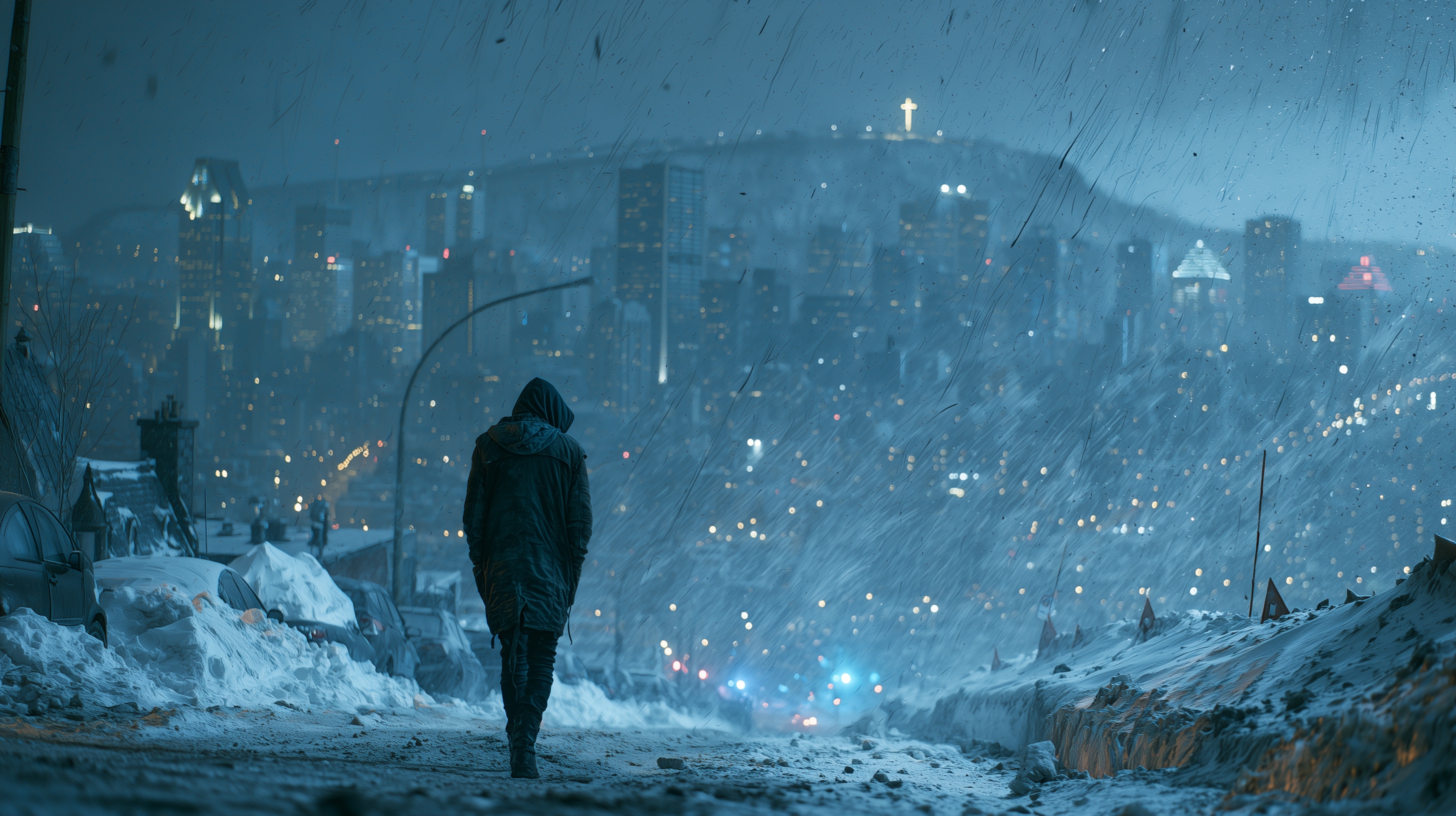
As a typesetter by trade, I was able to design a new cover, this time with the illustration assisted by Midjourney and a layout suggestion from ChatGPT.
As with the text, I brought everything back into a page-layout program to calibrate the cover in both French and English.
Claude also supplied the script to assemble it all into a professional ePub. All that's left now is to receive the ISBNs. That can take a while. First I had to register as a publisher with BAnQ. My two other ePubs were produced through a publishing service, since become too expensive, that supplied the ISBNs.
I'm pleased with the result, but above all with the process, which has the effect of freeing me, in a way, from the too-quick death of this book nearly thirty years ago. Hard Weather is probably the closest thing to who I am. I don't know whether I'll write this way again. I was young; I had a breath in me that isn't extinguished, but that comes harder now out of my lungs.
I should no doubt, for my own peace of mind, go back over L'Effet Casimir and perhaps Les Années rebours. Translate them above all — cast them upon the waters while I can still afford the Internet…
Claude pointed something out to me. The promenades currently on my site are, in a sense, the continuation of Hard Weather, since that intermittent blog carries the title of the book's interleaved pieces.
"You never stopped writing your promenades," it concluded.
After that, one wonders why we anthropomorphize these bits of code…
The text is available here: https://guyverville.ca/en/online-books/hard-weather